
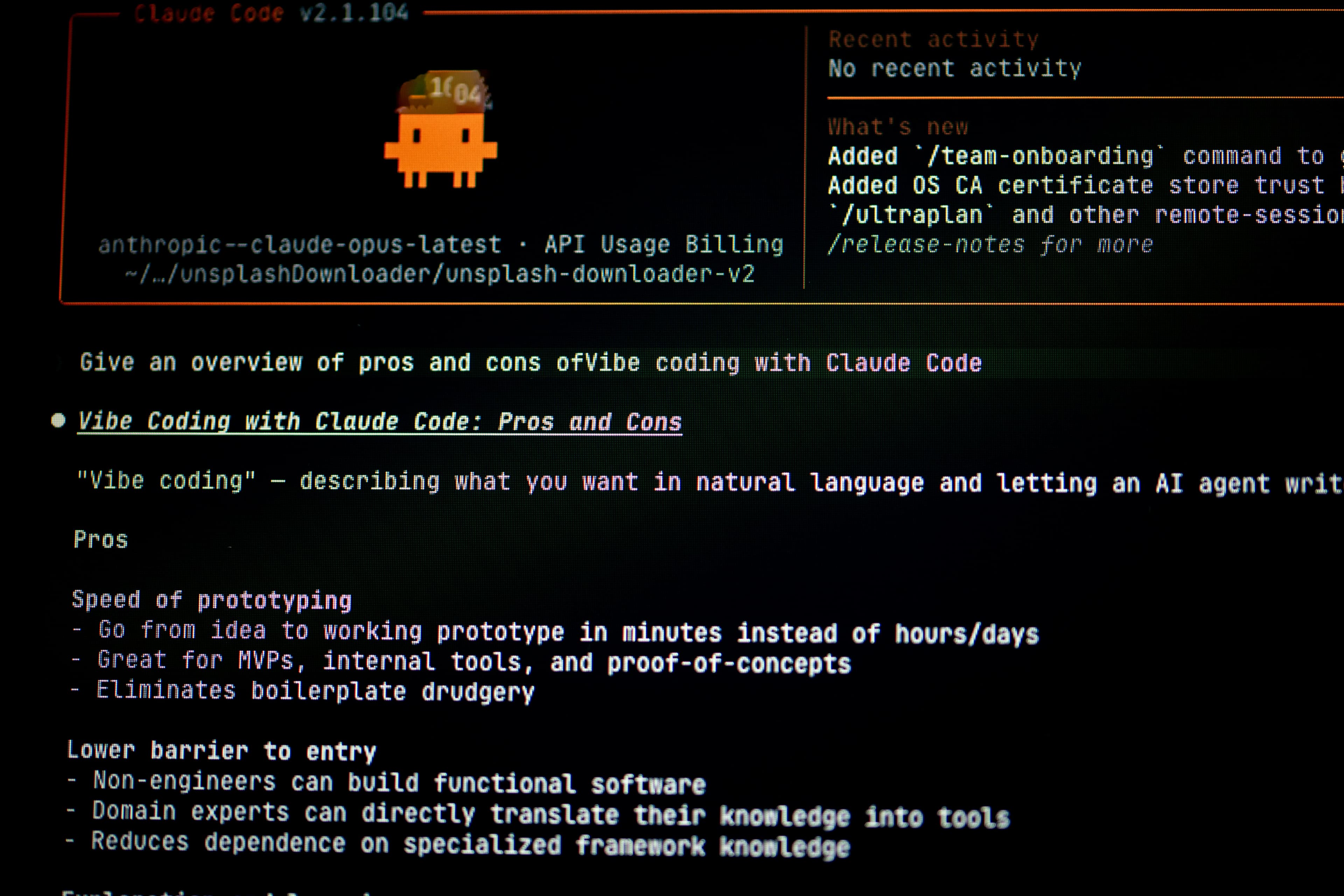
A new term has been circulating in developer circles over the past year: "vibe coding." It's informal, half-joking, and yet it describes something real — a shift in how software actually gets written when AI models are doing a meaningful chunk of the typing. Instead of carefully planning every function and writing code line by line, developers describe what they want in natural language, let an AI generate a working draft, and iterate from there based on whether it "feels right" and behaves correctly. Less architecture diagram, more conversation.
Having spent the last year building products this way — MVPs, automation pipelines, AI-powered platforms — I think vibe coding is less a fad and more an early signal of where software development is heading. But it's worth being precise about what it actually changes, and what it doesn't.
What Vibe Coding Actually Is
At its core, vibe coding is development driven by iterative prompting rather than upfront specification. You describe a feature, the AI produces code, you run it, see what breaks or feels off, and describe the fix. The loop is fast — often faster than writing the equivalent code by hand — and it lowers the cost of trying things. Instead of spending thirty minutes designing a function before writing it, you can have a working version in two minutes and refine from there.
This works especially well for prototypes, internal tools, and MVPs, where the goal is to validate an idea or get something usable in front of a client quickly. It works less well, unmodified, for systems where correctness, security, or long-term maintainability are non-negotiable from day one.
Why It's More Than a Trend
Skeptics frame vibe coding as sloppy — code written without real understanding, held together by whatever the model happened to produce. That criticism is fair when vibe coding is treated as an endpoint. It's much less fair when it's treated as the first draft of a process that still includes review, testing, and refactoring.
The deeper shift is this: the bottleneck in software development has historically been the gap between having an idea and having working code. Vibe coding compresses that gap dramatically. A developer who used to spend a day scaffolding a feature can now have a rough version running in minutes and spend the rest of the day on the part that actually requires judgment — does this solve the right problem, is the architecture sound, will this hold up under real usage.
That's not a lowering of the bar for engineering. It's a reallocation of where engineering effort goes.
The Skills That Matter More, Not Less
There's a common assumption that vibe coding makes deep technical skill less necessary. In practice, the opposite is closer to true for anyone building something meant to last. When AI is generating most of the code, the developer's value shifts almost entirely to the parts a model can't reliably do on its own:
Knowing what to ask for. Vague prompts produce vague, often subtly broken code. Precise prompts — that specify edge cases, constraints, and intent — produce dramatically better output. Prompting well is itself a technical skill.
Recognizing when something is wrong. AI-generated code can look correct and still have a logic error, a security gap, or a performance problem that only an experienced eye will catch. Without that judgment, vibe coding just produces bugs faster.
Architectural thinking. Models are good at generating a function or a component. They're much less reliable at deciding how those pieces should fit together at a system level — how data flows, where state lives, how services talk to each other. That's still squarely a human responsibility.
Knowing when not to vibe code. Authentication logic, payment handling, data migrations — some code deserves the slower, more deliberate process. Part of the skill is recognizing which parts of a system fall into that category.
In other words, vibe coding rewards developers who already understand software deeply, and it's far riskier in the hands of someone who doesn't — because there's no internal check on whether the output is actually sound.
What This Looks Like in Real Projects
In practice, the most effective version of vibe coding I've seen isn't "let the AI build everything." It's a tight loop: scaffold quickly with AI assistance, test immediately, fix what's broken, and treat the AI as a fast collaborator rather than an autonomous engineer. For MVPs and client builds especially, this approach has compressed timelines that used to take months into weeks, without sacrificing the parts of the product that actually need careful design — data models, integration points, security boundaries.
The teams getting the most value from this aren't the ones blindly accepting whatever a model outputs. They're the ones who've built a workflow around it: clear prompts, fast feedback loops, and a developer in the loop who knows exactly where to slow down.
Where This Goes Next
Vibe coding will keep getting faster and more capable as models improve, but the fundamental shape of the skill set probably won't change much. The developers who thrive won't be the ones who can write the most code by hand — they'll be the ones who can describe a problem precisely, evaluate a solution critically, and know the difference between code that works and code that's actually good.
The vibe is real. The judgment underneath it is what makes it useful.


